
I’m coming into LA with zero goals. I just want to live my life and see what happens. Rub elbows with some people and have a good time. If something great comes out of that, cool. I’m just going to take it in stride and appreciate the small moments in the communities that I can build here with the people that I think are on the same page.
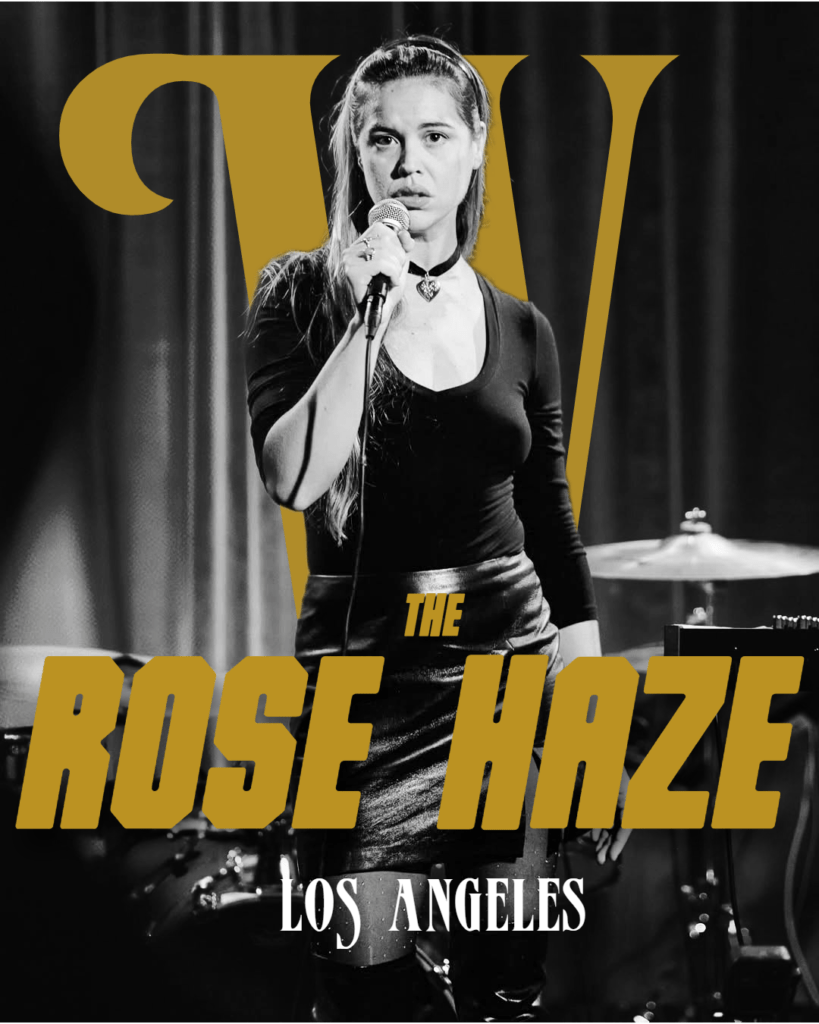
Generation W spoke to LA-based the Rose Haze ahead of her performance at Generation W: Los Angeles – The Hotel Cafe from 7PM Friday 1st May 2026 – Get Your Tickets Here
PHOTOGRAPH BY CHICLEDEUVA
Rose Haze: I grew up in a really small rural part of Ohio known as Shelby, which no one knows about. I grew up around music. I had a grandma who was an organist. I had aunts who were pianists. My dad was a guitar player.
GW: What is it like to grow up in Ohio?
Rose Haze: It’s a four seasons kind of place. You get super cold winters, but you have the fall leaves, and nice summers that can be a little too hot. It’s a beautiful state in terms of farms.
It’s in The Rust Belt. Things have, like a lot of rural America and maybe a lot of the rural globe, sort of disintegrated. It’s difficult to live an artistic life in those places. You have to seek it out in different ways.
You can move to Cleveland, Columbus, Chicago or New York, but it’s not spiralling in the same way I would like.
I moved to New Orleans, Europe, I ended up in Hawaii for a bit.
That’s when I found myself in California with a very intentional ambition with my music. That was just before the world shut down.
GW: Being from The Rust Belt, have you ever written any songs around that?
Rose Haze: My first two albums I recorded with Lisa Belladonna in Ohio. Everything has sort of a Midwestern feel to it. It’s quite different from the sound I have now. There were themes that were true to my struggles at the time. Just being who I was in those days in Ohio. After that, I thought, ‘okay, I’m going to go explore this feeling I have of traveling the world and seeing things outside of this place’.
I had a rough time as a child, to be quite honest. My inner world was difficult and my outer world, I didn’t seem to fit in in anything.
As a kid growing up, I was a bit nerdy. I lived in my books and my pianos.
I felt drawn to older people. I would hang out with teachers. I would skip lunch and talk with my guidance counselor because I found the conversations more interesting.
I remember being eight or nine years old, sitting in my room thinking, I am not going to die in this state.
GW: What gave you the sense of belief that you had a life outside your home state?
Rose Haze: I went through college, I had other aspirations. I really wanted to go to music school. I wanted to be a Berklee student. But I didn’t have any money. And I thought it would be a high-stakes risk to go to school and end up back in Shelby as, like, a choir teacher or something.
There was no, ‘oh, I want to be in a band.’ Music was solely for me.
When I was 20 years old, I started going to this little jazz club in Columbus, Ohio called Dick’s Den. It was four hours of music with these high-level players. I was so entranced with the sounds they’d make.
I grew up listening to Black Sabbath, progressive rock, it’s my dad’s influence. Then I got into really obscure jazz albums.
These jazz musicians started performing with me. I was writing psychedelic folk music at the time.
I then got really into Joni Mitchell, her records are what really freed me to feel I could be a folk artist all over.
I could be myself. I could say the things I want to say. Those musicians in the bar also helped me feel like someone in particular. Stan Smith, a great guitarist, was like, “play what you hear”.
I just started writing as much music as I could.
None of my ‘peers’ understood what the hell I was doing.
And I thought, ‘well, I don’t care because this is what I like’.
I kept the company of older people. My audience was often not my age.
Then I thought, ‘well, I want to be with my among’ my peers.
Not that I want to fit in, but I want to get an angle on how to build hype. I actually got really upset because I felt rejected with my music. And I didn’t know how to market myself.
I did some traveling, when I was in Greece, I was thinking, ‘where can my music be honest and approachable? What does that sound like?’
I started listening to the Cocteau Twins on repeat in Greece. I would go to this little tavern in the back of old ruins, with great reverb.
I drank and I would sing along with these echo-like sounds. And I’m like, ‘I want this kind of a band.’
Then I moved to California and I met Ruben. He had that style of music down to a pot. We formed what is now Rose Haze.
It’s more ethereal. It’s more electronic. I had this synthesizer thing going on and I play electronic harp over it.
I have this more ethereal sound that evolved over me meditating on what is my songwriting.
I guess I don’t really play the folk stuff as much anymore.
GW: Coming from a working-class background, does LA respect that?
Rose Haze: I’m a very raw kind of person. I put myself out there in ways that most artists are afraid to. And I mean afraid to, in the sense of they feel the same way, they just won’t say it.
I think that people want to respect the working class. But with the way things are in the world, they actually don’t.
I was in the Bay Area for a while, it was like a tech dystopia.
We were all busting to make a scene but to appeal to the greater community was a nightmare.
I don’t know what it’s like on the inside of the LA industry right now, I’m too new.
This is celebrity money here versus tech money. There is still a huge resource here of people that have been doing this for years that can help you fulfil your dreams.
I’m about to put out a new album. I’ve been thinking about what is really important to me with this. I do want a label, I do want backing, but at what cost to my timeline.
GW: When you’re making music now, are you making music that people in Ohio would buy, even though it’s produced in LA?
Rose Haze: Oh, I think so. I think that now with the internet, that’s the interesting part.
In Shelby, my hometown, oh gosh no, there’d be like one person. If I did a show in Cleveland, it would go over really well, if I got the right bands on it.
GW: What drew you to LA?
Rose Haze: I moved to Hawaii, and I just did a lot of inner work. Meditating, dreaming. Wandering around aimlessly for a while.
I knew that I want to give it an honest shot and I could do that in LA. Being a kid from Shelby, not to age myself, in those days, California was the promised land.
Everything happened there.
It’s not really the promised land anymore. A lot of the people I talked to in the industry that are way up in it, they’ve been in it for years, they’re more depressed and jaded than I am. Like I have this weird optimism that people don’t have.
I wanted to go somewhere where there is a metropolis of artists. I wanted to be a small fish in a big pond and see what happens.
I had a very Daria mentality growing up. It was always laced with this optimism. I think good artists, they’ve lived the dark and lived the light.
Cynicism is not helping anybody.
If I’m going to go play shows, I still want my audience to feel like they’re an extension of my art. I want it to feel community.
There’s always a lot of cool things going on in the underground. But it’s harder and harder to seek those out. I want to inspire people to not lose that. Leave the expectations at home. You move to a place like LA, everyone has big dreams, then they can have a really rough time. I think finding that middle place is really important.
GW: Have you had experiences in LA that have affirmed your decision to move there?
Rose Haze: Oh, as soon as I got here. I’ve worked with some people here that really have the same idea about things as me. I feel like I have my community here. I have it in some other pockets of the world too.
I feel like some people get too wrapped up in the who’s who of things. I’m coming into LA with zero goals. I just want to live my life and see what happens. Rub elbows with some people and have a good time. If something great comes out of that, cool. I’m just going to take it in stride and appreciate the small moments in the communities that I can build here with the people that I think are on the same page.
I was ready to move to Mexico and be a harpist on a beach bar.
I think that being able to say no is really powerful in LA.
GW: What films did you like watching up growing up in The Rust Belt?
Rose Haze: I loved Total Recall – pre-digital film, high-end set, theatrical, kind of goofy, like the Batman‘s. I still go back, I’m on a James Spader kick right now. I’m 10 years late to the blacklist, right?
I liked The Sandlot. It seemed like an all-American film to me. A baseball film, these little kids that have this summer friendship. It’s just kind of cute. That is Ohio summer when I was growing up. It captures the feeling of nostalgia that I have that really doesn’t exist when I go home anymore.
GW: Do you think there will ever be a situation where the whole of America will be comfortably simple again?
Rose Haze: I don’t know. I think about this because I believe order follows chaos. I don’t know if I can touch that one with any real concise opinion, because it just seems to me, even though I’m optimistic about my world, I am not optimistic about the future.
No one wants this inauthentic junk, right?
I think people are craving community in this country. I go to Mexico, I have a blast.
It’s like people have a community there. They have a culture. Europe has culture.
In some ways I like to go to my little small town in Ohio, even though it’s a bit too whitewashed for me, a bit too narrow-minded, there’s still a bit of a sense of, they believe in their stuff.
I just feel like these bigger cities have kind of lost that, ‘what are we doing here’. You have to find it in small pockets. You have to seek it out.
GW: What’s the new album about?
Rose Haze: It’s a Frankenstein. It’s kind of two albums enmeshed. I took about half of the album that was ready to be produced by former Smashing Pumpkins guitarist, Jeff Schroeder.
I presented that set of demos to him with my best friend, Ruben. We went down and we cut two songs, we were going to make a straight ahead goth rock, ethereal shoegaze album. We had this vision for it. Then Ruben died of cancer suddenly out of nowhere.
I had a blackout year in 2025. I went to a cabin in the middle of nowhere and produced raw vocal and piano. Like I used to do back in Ohio.
It was like a rewind, to go back to that era of time as a true songwriter. No bells and whistles, stripped back and raw. I have combined those two albums. I’m now finding the common thread sonically of where it fits.
It’s about the end of the world. And I think the end of the world has happened before and will happen again.
It’s about aliens, it’s about robots, it’s about post-nuclear winter, it’s about heartbreak. It’s got a theme of all of that on there. It’s dense lyrically, but musically it’s not that intense.
GW: This being a dark theme, is it making your days dark to think and talk about?
Rose Haze: That is a really great question. No. And that is why I approached it.
I put out a couple singles since Ruben passed. And those were my dark moments. The grief, specifically about him. But my concept now about the themes I’m writing about is at the end of each. These things are happening, but the lens is hopeful. It doesn’t matter that these things are happening. We’re here and we have to do something with it, one way or another.
Do the best you can and just ride it out. Because this isn’t the first time the world’s been in disarray or something. I guess that’s kind of the thought.
I think it’s about my process of believing that myself. What’s weird is when you’re writing the songs, there’s a sense of darkness of it, like, where are these songs coming from?
To me, it’s more humorous than it is dark.
GW: Does it feel like a temporary record for you? If it creates success for you and opens you up – will that give you space to feel like the world is not going to end on the next record?
Rose Haze: I don’t think it would necessarily change the way I feel about the external world, but my place in it would definitely.
GW: Has your workrate increased in LA with the pace of the city?
Rose Haze: Yes, because I’m immersed in it. And that’s vital to me. I want to either be all in or all out, which is the way I am. The world’s at a weird place, let’s say, industry-wise, economically-wise, politically-wise.
I’m out to be in it. I want to go to the things. I want to show up to the things.
I want to interact with people.
GW: Your last show at The Moroccan Lounge in LA, how was that?
Rose Haze: Such a wonderful night. I knew the headliner Soft Palms. Husband and wife. They’re super, they just wrote a book about how to be successful on your own in the industry.
They throw a cool festival in Long Beach. They’re LA through and through.
The show with them was a Desert Daze show.
GW: What is Rose Haze?
Rose Haze: People think my name is Rose, whatever.
But it’s a concept. In fact, it’s like the Dali Rose, if you’ve ever seen the Salvador Dali painting of the desert rose. Anyway, that’s sort of the image that comes in my mind, where it’s like rose-colored lenses with a little bit of fog.
It’s not always going to be pretty, pretty out there. But it’s like the perfect balance of how to approach life for me. I’m going to put on my rose-colored lenses, but I’m going to prepare to walk through the fog.
I want to build my own scene. I want to be like a witchy coven with a feminine forward, which is your thing, right? The whole female-forward thing.
I want to get the women I love and trust involved in the things I do and try to put our heads together. To create our own community that can branch out and be its own thing.