
One day my grandma caught me dancing on the table and she told my dad to come and watch. They hatched up a plan and they were like, “Hey, so we’re going to put you in dance school.”
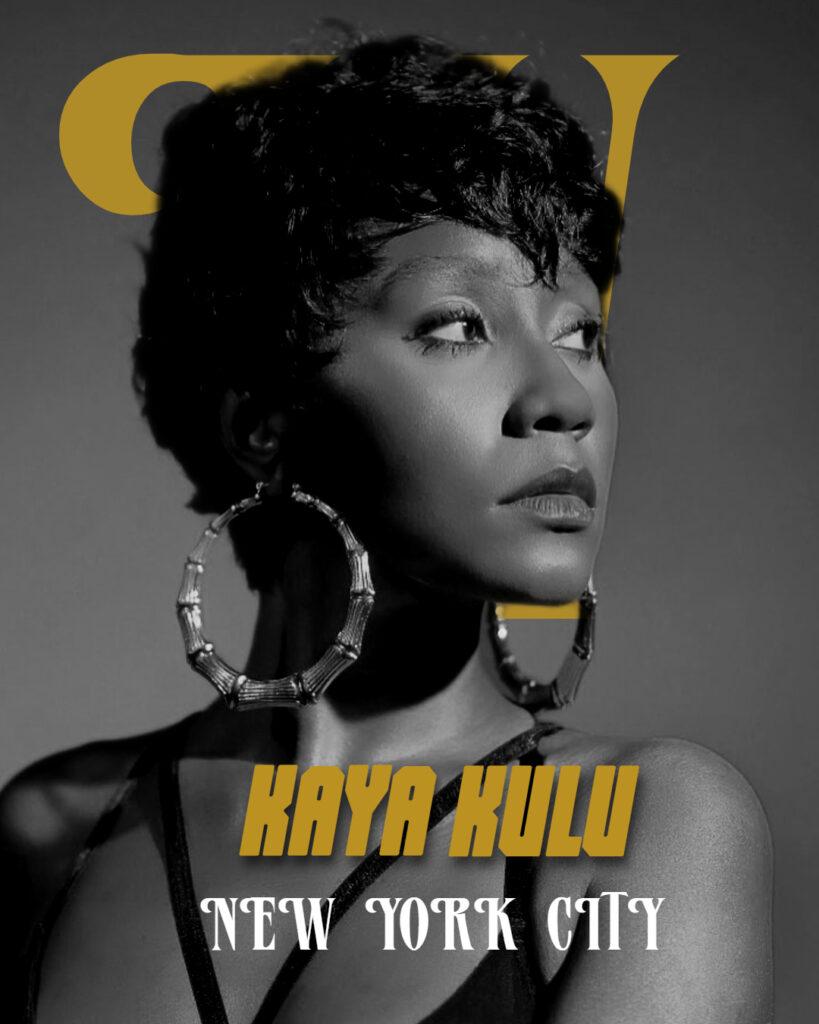
Generation W spoke to NY-based Kaya Kulu ahead of her performance at Generation W: New York City – Nu Blu from 7PM Monday 1st June 2026
Kaya Kulu: I feel like some people come to Brooklyn or they come to New York and they try to say how much they don’t like something with this weird hope that we’re going to be so accommodating and be like, “Oh, I’m so sorry you don’t like it. What can we change about it?” When honestly, we don’t care. There’s no consequence for being in New York and not liking hip-hop also, it’s okay.
GW: What age were you when you wrote your first lyric?
Kaya Kulu: I was 11. I had just finished my first ever musical where I played the lead for the first time. My mom and dad were not married, so I was living with her and her new husband. My siblings and I were cool, but I definitely felt some tension between my mom’s new husband and I. I was just really in a place where I was accepting, after the run of the musical, that this was what I wanted to do and that nobody else could tell me otherwise.
GW: What do you think gave you that confidence?
Kaya Kulu: It was how well the show had gone. When you come from a family like mine, especially being South African, a lot of the families of the diaspora, t’s either you can be a scientist, a doctor, an engineer or a lawyer. Anything else is just a waste of time, space, and energy.
We’re not even allowed to dream of doing extracurricular things, like being a dancer, being a singer, being a writer, unless it’s somebody who just writes essays or whatever. We’re not allowed to think of that.
I knew I wanted to do it since I was a child. I was in The Wiz, and I played Dorothy. My mom saw it, and she was like, “Okay, I get it.” She still wasn’t fully on board, but she was like, “I get it.” So once she said, “I get it,” I kind of took that and ran with it. I was like, “Yeah, I’m made to do this. So let’s go.”
GW: What generation did people in your family from South Africa come to New York?
Kaya Kulu: My mom was 14. My grandmother was a nurse and an activist as well. She was a nurse during apartheid. She worked in a hospital, delivering babies and tending to mothers. My mom and her two sisters all lived in South Africa. My grandmother had gotten into a situation at the hospital where there was a lot of discrimination going on, she staged a walkout. She was the ringleader and nobody wanted to get in trouble, so they gave her name up to administration. Then everything just kept getting crazy. Eventually, they had to flee South Africa due to apartheid.
GW: What age were you when you were really fluid in the fact that your heritage goes back to South Africa?
Kaya Kulu: We did a small report in fifth grade when I was 10. Then when I turned 13, I really got involved and learned a little more. As much as my mom would tell me.
GW: Did you feel different to other Black kids growing up in Brooklyn because your family were quite close to Africa?
Kaya Kulu: Yeah, I can definitely say I’ve always felt a little different, especially for the fact that a lot of the kids I grew up with in Flatbush, I’d never really met any Africans up until after high school. I met more Caribbean people, which was fine with me. There were some similarities and some differences. Some of the similarities were the ways that we celebrated, the ways that we had fun, the ways that we took care of each other. The differences were definitely little cultural differences, like some of the foods that we eat or some of the music that we listen to. I didn’t really get my first taste of soca or reggae or dancehall until I moved to Flatbush.
GW: What type of music would you say you are making now?
Kaya Kulu: I’d say hip-hop. I’m definitely making hip-hop, R&B and jazz. The Afro-Latin influences, the Afrobeat influences, the soca, the reggae, they haven’t shown their faces yet, but I know they’re there.
GW: Your mum’s from South Africa and your dad’s from Puerto Rico, is that right?
Kaya Kulu: Yes. Whenever I would split the weekends, one home was very African and then the other household was different types of celebrations. My grandmother was always home. She was always feeding me, always cooking, much like my mom, but she was always cooking. She was always talking to me about things.
GW: Was music a big part of both households?
Kaya Kulu: Absolutely. I saw my first musical at my dad’s house on tape. I saw Annie. One of the things that I used to do when I found something that I was really interested in was watching over and over. I had this hyper-fixation. One day my grandma caught me dancing on the table and she told my dad to come and watch. They hatched up a plan and they were like, “Hey, so we’re going to put you in dance school.” And I was like, “Okay, cool.”
My dad got me my first iPod. He showed me how to burn my first EP, showed me the Beatles, showed me Slick Rick, Michael Jackson. I had such a rich tapestry of music to dig into. It was never just one thing.
GW: You said you were dancing to Annie. Had you heard ‘Hard Knock Life’ by Jay-Z?
Kaya Kulu: No, I hadn’t heard it. When I moved to Brooklyn, that’s when I heard it. I moved from Staten Island. I moved in September. So that was Labor Day times. All these vibrant colors, all these vibrant smells, different block parties were happening.
GW: Brooklyn has been known to get behind its people. Does that still happen for musicians? Kaya Kulu: I just performed at the Brooklyn Academy of Music and not only was I able to be heard, I was able to be felt. It was packed out. People really enjoyed what they saw. A lot of people at shows are musicians themselves.
GW: Do you feel we live in a time where musicians are not being understood by the general population?
Kaya Kulu: I also think consumers are chasing after nostalgia in artists instead of trying to meet them where they are.
GW: You recently performed on stage at Blue Note. How was that?
Kaya Kulu: Blue Note was beautiful. It was so refreshing. It was my first time there ever. It was a really fun time. I had a great time. It was a transformative time for me as well. To be on stage with Steam Down and to be able to sing with them and get more of a handle on their lyrics and the things that they sing and write about. It’s really liberation music. It’s community music. Everybody was able to enjoy that.
GW: How did that happen?
Kaya Kulu: It’s a foggy story. We met through a friend who recommended me as a singer for them while they were here in New York the first time in 2024. We met on a whim at a jam session. I thought I was going to meet them on a Friday and ended up not meeting them on Friday and ended up meeting them on a Tuesday. One of the girls who manages, her name is Kaya. We were just talking to each other. I was like, “Wait, I heard a Kaya.” Then she comes to me, she goes, “My name’s Kaya.” And I’m like, “Hi, I’m Kaya.” I was like, “Wait, you’re who I’m supposed to be meeting in a few days.” So we kind of just hit it off from there.
GW: Kaya is not a common name right?
Kaya Kulu: It doesn’t feel common. I’ve been meeting a lot more Kayas. It’s so strange. I’d never heard my name growing up, if we’re being honest.
GW: What were the hip-hop records that really spoke to you and made you see the genre in a different light?
Kaya Kulu: “The World Is Yours,” “Children’s Story.” Definitely “Can’t Knock The Hustle.” I heard that a lot.
Growing up I went to middle school with Joey Bada$$, Kirk Knight and Dyemond Lewis (Pro Era). Seeing them come up was beautiful. I was older than Joey. He was in the drama club with me. We were cool because our birthdays were a few days apart. I knew that he rapped because I saw him on stage with another one of his classmates, who I’m also really cool with, and they were rapping at a school assembly.
GW: You were all 11, 12, 13-year-olds rapping in assemblies?
Kaya Kulu: Yeah. Just seeing what each other might become and then years later, fast forward, you really became that.
GW: What was school like for you?
Kaya Kulu: I was usually an outcast. I was such a bookworm kid. Loved music. I hated math. I loved English.
GW: Do you think people are more open to seeing an independent artist in New York coming through and being bold and strong?
Kaya Kulu: I definitely hope so because I feel like there’s a lot of conversation around New York falling off or New York not being cool anymore. For whatever reason, there’s so much anti-New York propaganda going around. But I would hope that there’s still some openness to artists coming out of New York that actually have something to say.
GW: Are you ready to take on your position as a leader in that?
Kaya Kulu: Oh yeah, for sure. Definitely ready.
GW: Nothing will faze you?
Kaya Kulu: No. Well, I mean, if I’m unfazed, then I think I’ve lost a little bit of my humanity on the way. But I feel like I need to have a thick skin and know what is for my benefit, and what is to my detriment. Having that discernment to know the difference will definitely help me along the way in life.
GW: Does it feel like New York’s got this whole unique scene building where people aren’t really looking for a deal and just enjoying making the music?
Kaya Kulu: I feel like a lot of people are overlooking the underground scene, it’s really rich with people who take their craft seriously, who really enjoy what they do and are putting a lot into it. I can’t say too much for the mainstream scene, because that’s not where I look for music.
GW: What are your plans for Nu Blu? What do you reckon your set’s going to be like?
Kaya Kulu: My main parts, of course, keys, bass, drums, guitar, and two horns. I definitely want to incorporate a lot of the things that I’ve been working on lately, and a lot of the things that I haven’t really had a chance to incorporate.
GW: How does it feel to be on this international lineup, with a British platform, Indian artists, Latin artists, and yourself Afro-Latin, doing that in New York?
Kaya Kulu: I’ve had a lot of homecomings in New York, having shows where it’s like, “Wow, this is really happening here. And I get to be a part of it, as a native.” It feels very good. It feels like another homecoming.